
.png?width=173&height=43&name=Logo%20(1).png)

-1.png?width=38&height=34&name=Vector%20(2)-1.png)
-1.png?width=34&height=34&name=Vector%20(3)-1.png)

AI Series: Its latest tell-tale fault

The old giveaways have been fixed.
If you’ve read other entries in our AI series, you previously read about some of the ways you could tell if AI was used. As one of the fastest evolving technologies in world history (as far as we know), AI’s weaknesses are being solved at an unbelievably fast pace.
Weird hands? Not anymore. Everyone typically has five fingers.
Unrealistic, smooth lighting and finishes? Corrected, so images look like real-world lighting and textures.
“Melting” faces? While a celebrity face may still show some inaccuracies that you can spot easily, AI now creates realistic and correctly proportioned faces (most of the time).
Photos are so good now that even AI detection sites are having a harder time flagging content. But in videos, at least for today, I've noticed a new giveaway: AI is still unrealistic.
Reaction times and speech patterns are too fast.
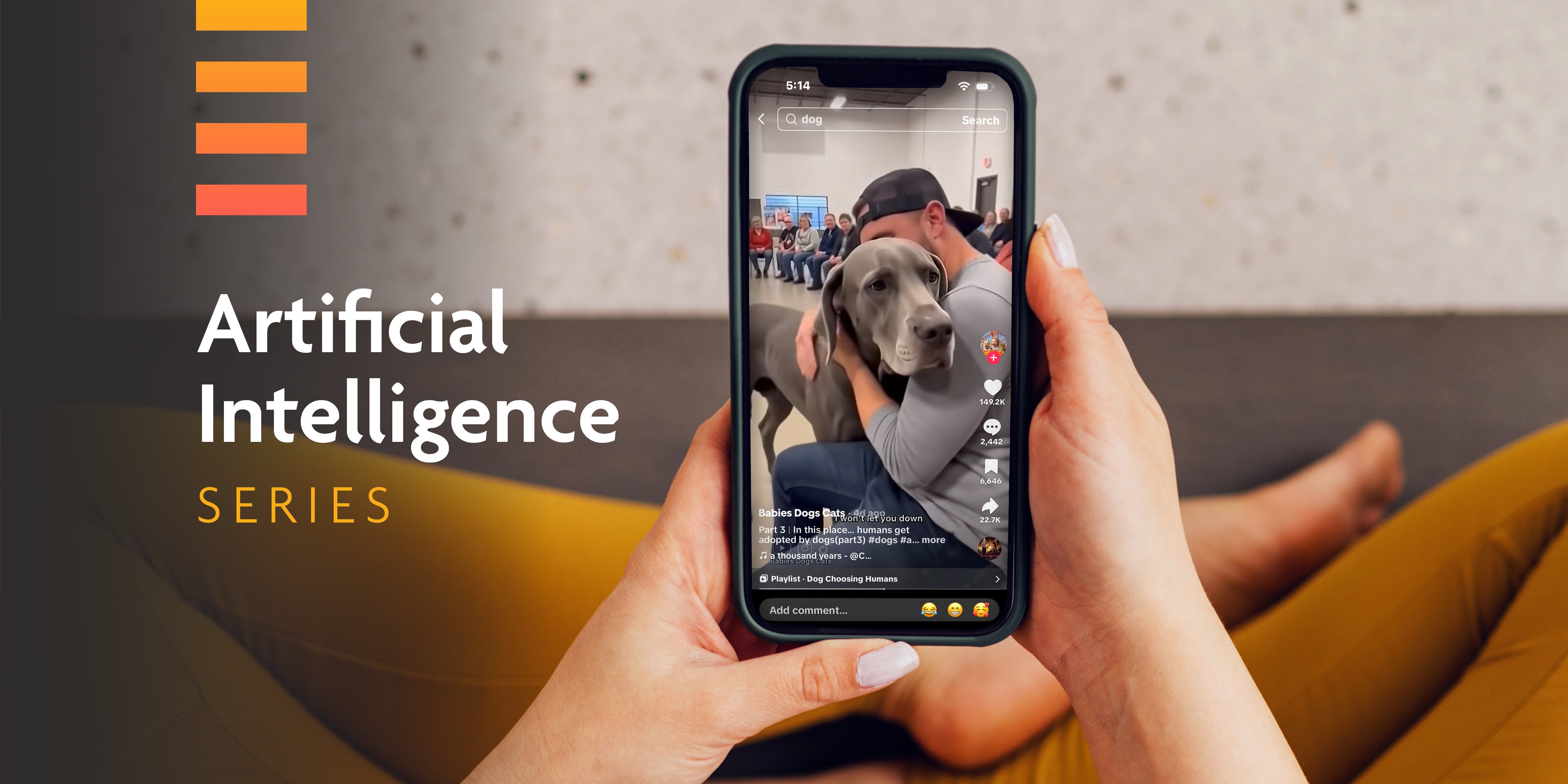
If your social media feed looks like mine, you might see a lot of dog videos with heartwarming things that dogs do for people. I have seen a couple of videos now of a place where, instead of humans adopting dogs by selecting one from their crates, the dogs enter a room with potential adopters who select the one they want to take home. They’re tear-jerkers… until you notice that something’s a little off.
The problem is not that the room is packed with people willing to adopt any dog that approaches them. If that were the case, there wouldn’t be full kennels anywhere. The giveaway is in other details.
There are a few ways to tell if a human interaction in AI is unrealistic:
- Every person is very quick to respond. There are no natural pauses for someone to think before they speak.
- Everyone is incredibly confident. Nobody laughs, stutters, breaks eye contact, or mumbles. One bold statement is immediately met with a bold response, spoken clearly and confidently.
- Reactions are exaggerated. In the “dogs pick their humans” video, everyone cries. Whether it’s a young girl, an elderly man, or anyone in between, it’s a real Hallmark movie reaction every time.
Warmth is still the differentiator.
As always, and no matter how fast AI is coming along, it still lacks some of the finer points of human warmth. In the AI world, people don’t process thoughts or feelings, consider their responses, or feel any apprehension. These “people” know their lines, and they’re just waiting for the other “person” to stop talking so they can loudly and confidently proclaim theirs.
Of course, this may all be temporary, too. Hollywood’s best actors nail the finest details of human emotion, like small facial expression changes, pauses, and speech patterns. Surely someone working at OpenAI or Google is feeding Denzel Washington and Meryl Streep clips into the machine, aiming for even more realistic human emotion. Will it get there? Probably. But for now, watch for these signs of AI-generated videos.